
How to prevent mould on your bathroom ceiling
Get the steam out of the room. Run a working exhaust fan during every shower and for about 10 minutes after, open a window if you have one, and check the fan's air is leaving the house. Clean off what's there first, then fix the cause, or the mould will be back.
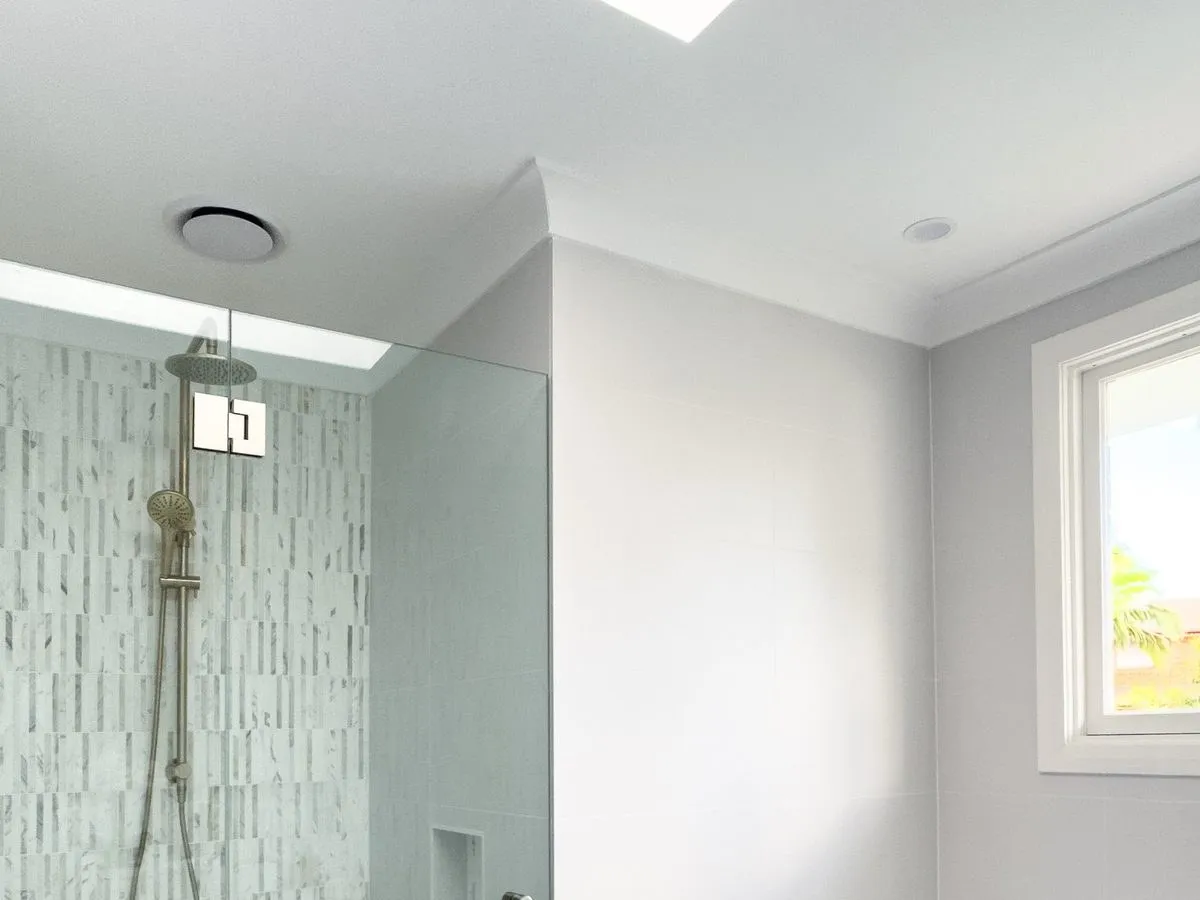
Photo at the top: a bathroom we wired in Pagewood. Photography: Melissa Heath Interiors.
Why does mould grow on a bathroom ceiling?
Warm, wet air rises, then turns to water on the cooler ceiling. The Australian Building Codes Board says mould can develop once humidity at a surface goes above 70%, and a ceiling above a hot shower gets there easily. The usual reasons it stays that way:
- There's no exhaust fan, or it isn't pulling much air.
- The fan goes off when you do, and the room stays steamy.
- The fan blows into the roof space instead of outside.
- A patch of ceiling is colder than the rest, or a leak above is keeping it wet.
How do you clean it off?
NSW Health suggests mild detergent, or 4 parts vinegar to 1 part water. If that won't shift it, use 250 ml of bleach in 4 litres of water, with the room well ventilated. Wear rubber gloves and eye protection, because you're working overhead. Better Health Channel (Victorian Government) also suggests a P1 or P2 face mask.
Two warnings from Better Health. Never mix bleach with ammonia, acids or other cleaners, because that can release hazardous fumes. Vinegar is an acid, so if you've used it, rinse with clean water and air the room before you use bleach. And some people shouldn't remove mould or be there while it's removed, including pregnant women, children, and people with weakened immune systems or chronic lung disease.
Let the ceiling dry fully before you repaint. If the plasterboard is soft or stained right through, NSW Health's advice is to discard material that can't be cleaned and dried completely. That's a repair job rather than a cleaning job. Don't sand or drill a ceiling in a home built or renovated before 1990 until you know what it's made of, because it may contain asbestos.
Is your exhaust fan doing its job?
You can check this in a minute, without tools:
- Try the tissue test. With the fan on, hold a sheet of toilet paper near the grille. A fan that's pulling properly should hold it there. If it drops, the fan isn't moving much air. It's a rough check, not a measurement.
- Clean the grille. Turn the fan off first. A grille clogged with dust can be most of the problem.
- Time it. Does it stop the moment you leave? The National Construction Code says a new bathroom without natural ventilation needs a fan that runs on for 10 minutes after the light goes off, at 25 litres a second or more. An older home may not have that, but it's a useful yardstick.
Leave anything behind the grille alone. By law, electrical installation work has to be done by a licensed electrician.
Where is your fan's air actually going?
This is the one most people never check. The current code says bathroom exhaust has to go to outdoor air, directly or through a shaft or duct. Earlier editions allowed it to go into a ventilated roof space, so plenty of existing fans still blow up there. That takes the damp air out of the bathroom, but not out of the house.
If you can get into your roof space safely, look for a duct running from the fan to the outside. If you can't, or you're not sure, we can check when we come and look. When we fit exhaust fans for bathrooms and laundries, they're ducted outside so the damp air leaves the house.
Before you go looking: if your house was built or renovated before 1990, NSW Government advice is that it's likely to contain asbestos. Don't go into the roof space or sub-floor if you think there could be loose-fill asbestos insulation, which can only be identified by testing. If in doubt, stay out. Don't touch cables or insulation.
What if the fan is fine and the mould still comes back?
- Look at where the mould is. One patch, rather than the whole ceiling, points to a cold spot or a leak. Check for missing insulation above it, if it's safe to get up there.
- Look for staining. A brown ring or sagging plaster suggests water coming from above. A roof leak is one for a roofer.
- Look at the rest of the house. If you've also got mould in wardrobes or a musty smell, the moisture may be coming from under the floor.
Need a new exhaust fan, or an old one ducted outside? Book a time for us to look. You get the quote in writing, and once you say yes, the price doesn't move. We work across the Northern Beaches, the North Shore, the Eastern Suburbs and the Inner West.
Prefer to talk now? Call 0466 805 580.
Common questions
How long should I leave the bathroom fan on?
About 10 minutes after you finish. That's the run-on time the National Construction Code sets for new bathrooms without natural ventilation, and it's a sensible habit in any bathroom.
Can I replace the exhaust fan myself?
You can clean the grille yourself, but by law electrical installation work has to be done by a licensed electrician. Our licence is NSW Electrical Contractors Licence 503808C.
Do I need a mould test?
Usually not. NSW Health says most mould is visible, so it's generally not necessary to test for it at home, though some can sit in cavities or the ceiling.
Where this comes from
Sources checked on 7 November 2026.
- Australian Building Codes Board, Condensation in Buildings handbook (2019)
- NSW Health, Mould fact sheet (last updated 20 December 2022)
- Better Health Channel (Victorian Government), Mould removal at home (reviewed 8 October 2020)
- National Construction Code 2022, Housing Provisions, Part 10.8 Condensation management
- NSW Government, Avoiding electrical accidents
- NSW Government, Asbestos (NSW Planning)
- NSW Government, Working in pre-1980 built homes (loose-fill asbestos insulation)
