
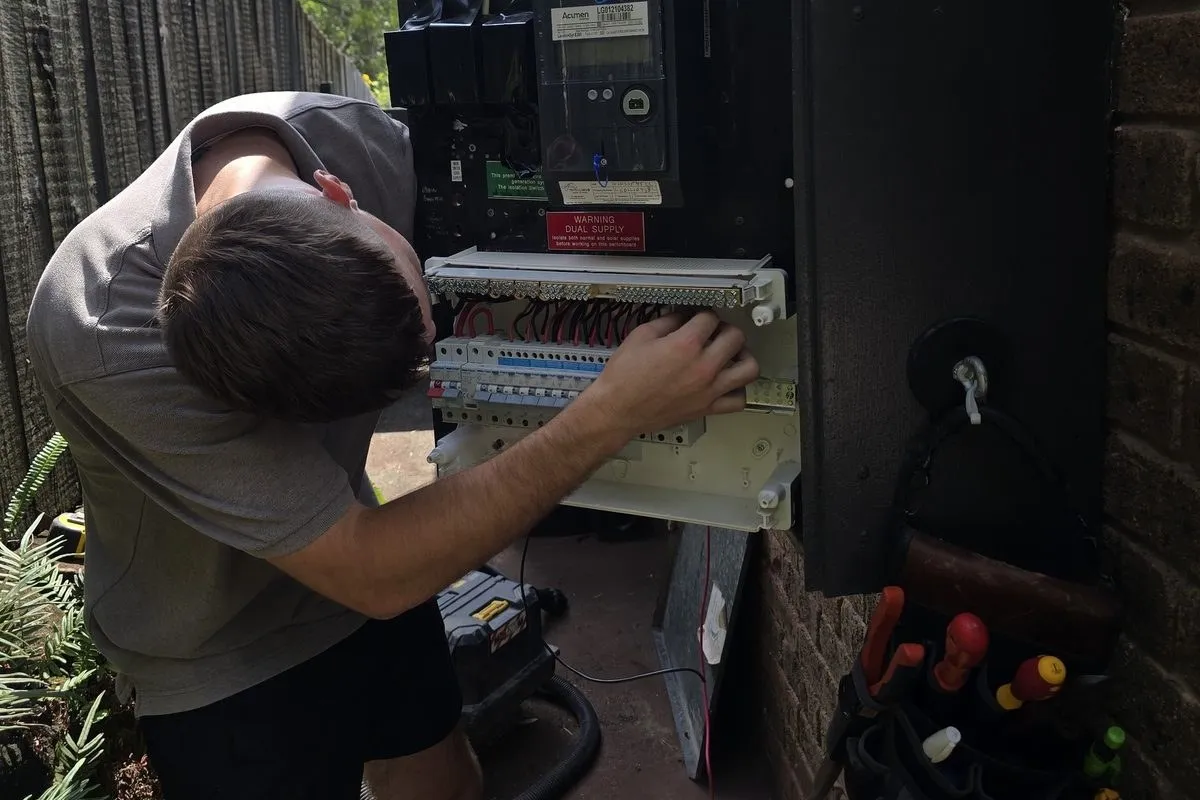
Do I need a switchboard upgrade? When an old fuse board can stay
Not always. We haven't found a NSW rule that makes you replace a working switchboard just because it's old. It's worth having it looked at if you still have ceramic fuses, if only some circuits have safety switches, if it buzzes or keeps tripping, or if you're adding something big like an EV charger. If yours can stay, we'll tell you.
What are the signs a switchboard needs work?
The NSW Government and Ausgrid point to most of these:
- An old fuse box or ceramic fuses. Replacing an outdated fuse box is the first reason NSW gives for an upgrade.
- An original board in a home 25 years or older. NSW says you may need an upgrade. Age alone doesn't prove anything is wrong, but it's a good reason to look.
- Frequent flickering lights or buzzing. NSW lists both as warning signs. Ausgrid says to contact a licensed electrician immediately if fuses blow constantly, or if you notice buzzing or sparking on the board. Flickering has other causes too.
- Safety switches on only some circuits, or none. The NSW Government says you need them on all circuits to be fully protected.
- It trips when two big appliances run together. That's a board or circuit running short of room. If it's a safety switch tripping instead, start here.
- An old hinged wooden board. Ausgrid flags these, along with obsolete service fuses, for a safety check.
- Something big is coming. NSW says an EV charger, induction cooktop, central heat pump, rooftop solar or home battery may require an upgrade.
Does NSW law make you upgrade an old board?
Not for age alone, as far as we can find. These are the things that can bring it on:
- Changing the installation. Building Commission NSW says work that changes protection, capacity or how circuits are arranged is an alteration. The altered part has to meet the current Wiring Rules, and existing protective devices it affects have to be assessed. Replacing something with the same type, loading and location is generally a repair. So a new circuit can bring your board into the conversation, when a like-for-like swap wouldn't.
- A defect notice. Ausgrid says everything from the first connection point onwards is yours to keep safe. It can issue a notice for faulty or deteriorated wiring, and if that isn't fixed within 21 days, the property may be disconnected as a last resort.
- Renting the place out. NSW Fair Trading treats a faulty safety switch, or one tripping because of an electrical fault, as an urgent repair.
When can an old fuse board stay?
When a licensed electrician has checked it's in good condition, nothing big is being added, and the circuits you use every day are protected. A fuse protects the wiring. A safety switch is there for people: it turns the power off immediately if an electrical fault is detected. So a working fuse board with no safety switches is the case we'd talk through with you, even though it's still working.
The answer can be smaller than a new board, and sometimes a new board is the cleaner job. We'll tell you which, and why, when we come and look.
What can you safely check yourself?
- Look, don't touch. Only open a proper door on the board. If the whole board hinges out, or you can see bare wires, leave it. Stay away if it's wet, buzzing or hot, if it smells of burning, or after a shock or tingle. Don't remove any covers or pull out any fuses.
- Look for a "T" or "Test" button. That's a safety switch. Count them, and read which circuits they cover if the board is labelled.
- Test them. Tell everyone first, press the button, and the power on that circuit should cut off. Then move the switch back to on. Some need pressing fully to off first. The NSW Government says to do this at least every six months, and NSW Fair Trading says every three. If the power stays on, or it won't reset, call a licensed electrician.
That's where it stops. NSW Government advice is that DIY electrical work is dangerous and illegal, and that you shouldn't do electrical maintenance beyond changing a light globe.
Could an old switchboard contain asbestos?
Yes. The NSW EPA lists electrical switchboards among the places asbestos turns up in homes built before the late 1980s. The national asbestos agency says older backing panels, mostly installed before 1990, are dark brown or black with a rough, fibrous or wood-like surface, and may smell of tar. You can't tell by looking. Only testing confirms it, so the NSW EPA's golden rule is to treat it as asbestos if you think it might be.
The NSW EPA says asbestos that's sealed, undisturbed and in good condition is very low risk. It's a hazard when it's damaged or disturbed, and the agency warns that drilling, cutting, sanding or water blasting these panels may release fibres. These boxes may also hold loose asbestos dust. So leave it alone, and don't wipe, brush or vacuum inside. If a panel has to come out, the NSW EPA recommends a licensed asbestos removalist in all cases. Ask how it will be handled before work starts.
What happens when a board is upgraded?
- Old fuses come out and safety switches go in. The types have changed too: Type AC safety switches can't go into new electrical work in Australia, as of 1 May 2023.
- If the supply or meter needs work, that takes a Level 2 service provider. We tell you first and organise them.
- Once the job is done and tested, you get a Certificate of Compliance for Electrical Work (CCEW). Building Commission NSW says it shows the work was tested and complies, and that it can help with warranty claims.
Still on fuses, or not sure what you have? Book a time for us to look. We'll tell you if your board can stay. If it can't, you get the quote in writing. Once you say yes, the price doesn't move. If we open something up and find a real surprise, we stop, show you, and quote it before we go any further. We work across the Northern Beaches, the North Shore, the Eastern Suburbs and the Inner West.
Prefer to talk now? Call 0466 805 580.
Common questions
Is it illegal to have a fuse box in NSW?
We haven't found a NSW rule that bans a working fuse board in an existing home. That doesn't mean it's as safe as a board with safety switches, and work on the installation can bring its own requirements.
Do I need safety switches on every circuit?
We haven't found a rule requiring it in an existing NSW home, though NSW says you need them on all circuits to be fully protected. When we add to or change a circuit, we recommend a safety switch on it, and a new switchboard from us gets one on every circuit.
Will an EV charger mean a new switchboard?
Not always, though old fuse boards usually do. We check at the visit and tell you before we quote. Here's what else changes the cost of a charger.
What else do you do?
Lighting, power points, rewiring, smoke alarms, fans and fault finding. See our Electrical page.
Where this comes from
Sources checked on 7 November 2026.
- NSW Climate and Energy Action, Switchboard upgrade (updated 9 July 2026)
- Ausgrid, DIY and home maintenance
- NSW Government, Safety switches protect you (last updated 31 May 2021)
- NSW Fair Trading, Electrical safety requirements and consumer rights (updated 1 July 2026)
- NSW Government, Electrical safety in the home
- Building Commission NSW, Note 3/2026 Alterations to electrical installations (6 October 2026)
- Building Commission NSW, Note 2/2025 Residual current device compliance (February 2025)
- Ausgrid, Safety defects
- NSW Fair Trading, Electrical safety in a rental property
- NSW EPA, Was your home built before the late 1980s? (March 2019)
- Asbestos and Silica Safety and Eradication Agency, Electrical fuse/meter board backing
- Building Commission NSW, Electrical compliance requirements (updated 19 October 2026)
