
Why does my safety switch keep tripping?
It's usually doing its job. A safety switch turns the power off immediately when it detects an electrical fault. Often the cause is an appliance, and plugging things back in one at a time can find it. If it trips with everything unplugged or won't reset, call a licensed electrician. If anyone felt a tingle, stop and call Ausgrid on 13 13 88.
Before you touch anything
If anyone got a shock or a tingle: stop. Don't touch or re-test whatever caused it, and keep everyone away until Ausgrid and a licensed electrician say it's safe. Call Ausgrid on 13 13 88, any time of day. If it came from something metal, like a tap or sink, Ausgrid says to call 000 as well, and to stay away from taps, sinks, stoves, laundry tubs and water. It also says not to turn the power off at the main switch, because it's often in a metal enclosure that can shock you. If someone is being shocked, don't touch them: call 000. Healthdirect says to see a doctor even if a shock seemed mild.
If the board is wet, buzzing, sparking or hot, or smells of burning, stay away from it. Ausgrid says to contact a licensed electrician immediately if there's buzzing or sparking. If there's smoke or flames, get out and call 000.
Is it a safety switch or a circuit breaker?
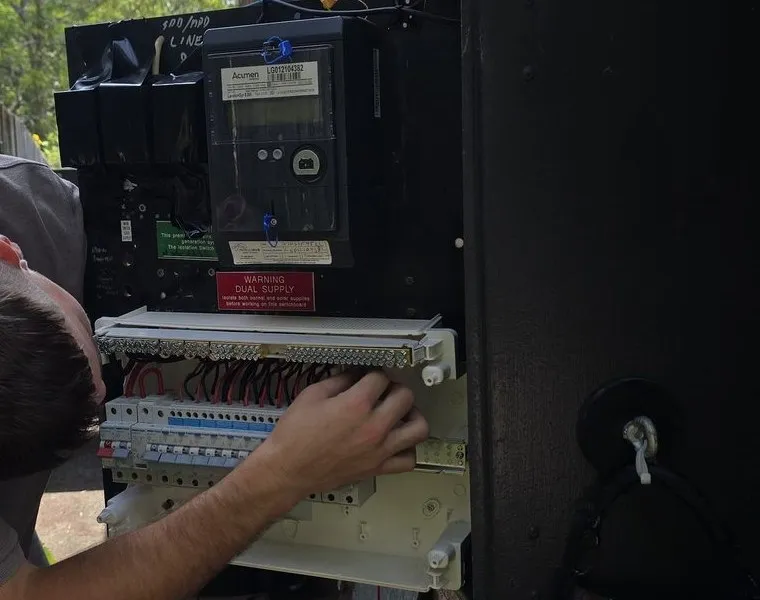
Open the switchboard door and look at the switch that's moved to off. A safety switch has a "T" or "Test" button on it. It trips when it detects a fault, and it can cut several rooms at once.
A circuit breaker protects the wiring, and usually trips when too much is running on that circuit or there's a short. If a breaker trips, turn a few things off before you reset it. Ausgrid warns that overloading a board can be dangerous, so call an electrician if it keeps happening.
How can you find what's tripping it?
NSW Government pages cover testing and resetting. The method below is common trade advice, and it only involves things you're allowed to do: unplugging appliances and moving the switch.
- Unplug everything you can. Switch off and unplug the appliances in the rooms that lost power. Don't touch anything that's wet.
- Reset the switch. Move it back to on.
- If it stays on, plug things back in one at a time. Leave out anything wet, damaged or scorched. Run each one for a while before you move to the next. If the switch trips, the last thing you plugged in is your suspect. Stop using it. Have it repaired by someone qualified, or replace it.
- If it trips with everything unplugged, the fault is probably in the wiring or in something fixed in place, like an oven, a hot water system or outdoor lights. Don't keep resetting it. Call a licensed electrician.
- If it won't reset at all, press it fully to off first, because the NSW Government says some switches need that. If it still won't reset, call a licensed electrician to replace it.
Never tape, hold or bypass a safety switch to keep the power on.
What usually causes it?
- An older appliance. Anything with a heating element or a motor is a common suspect, such as a kettle, heater, washing machine or dryer.
- A damaged cord. Ausgrid says to replace damaged or frayed cords, so stop using them.
- Water. If it only trips when it rains, water may be getting into an outdoor light, power point or cable. That's one for an electrician.
- Old wiring. The NSW Government says rubber insulation in older homes can crumble, and that homes built before the 1980s should be inspected. If you find old or exposed wiring, don't touch it. Don't go into the roof space or sub-floor to look, because homes built or renovated before 1990 are likely to contain asbestos.
What about a switch that never trips?
That's the one to check. Tell everyone first, press the test button, and the power on that circuit should cut off. Then move the switch back to on. The NSW Government says to do this at least every six months, and NSW Fair Trading says every three. If the lights and appliances keep working when you press it, the switch may have failed, so call a licensed electrician.
If only some of your circuits have safety switches, it may be time to look at the board.
What if you're renting?
Don't try to fix it. NSW Fair Trading says a faulty safety switch, or one that trips because of an electrical fault, is an urgent repair. Tell your landlord or agent right away. Landlords must make sure urgent repairs are done within a reasonable time.
What happens when you call us?
Fault finding is part of what we do. We find the cause and quote the fix, in writing, before we fix anything. For a problem that won't wait, call us. We do some after-hours work for urgent jobs, and we'll tell you if we can come.
Still tripping with everything unplugged? Book a time for us to look. Once you say yes, the price doesn't move. If we open something up and find a real surprise, we stop, show you, and quote it before we go any further. We work across the Northern Beaches, the North Shore, the Eastern Suburbs and the Inner West.
Prefer to talk now? Call 0466 805 580.
Common questions
Can I keep resetting it?
Only for the steps above. If it keeps tripping, it's telling you there's a fault, so stop and call a licensed electrician.
Is a tripping safety switch dangerous?
The switch is doing what it should. The fault it detected may be the danger, so find the cause rather than working around it.
Why did half the house go off?
One safety switch can cover several circuits, so one faulty appliance can take out more than one room.
Do you do other electrical work?
Yes. Switchboards, lighting, power points, rewiring, smoke alarms and fans. See our Electrical page.
Where this comes from
Sources checked on 7 November 2026.
- NSW Government, Safety switches protect you (last updated 31 May 2021)
- NSW Fair Trading, Electrical safety requirements and consumer rights (updated 1 July 2026)
- NSW Government, Electrical safety in the home
- Ausgrid, Shocks and tingles
- Ausgrid, Indoor safety tips
- Healthdirect Australia, Electric shocks and burns (last reviewed September 2025)
- Ausgrid, DIY and home maintenance
- NSW Fair Trading, Electrical safety in a rental property
- NSW Government, Asbestos (NSW Planning)
