
Do I need a wall charger, or will a power point do?
Many drivers can start with a power point. NRMA says the average Australian drives under 40 km a day. RACV says a standard point adds about 10 to 15 km an hour, so a night plugged in can cover it. Have a licensed electrician check the point and circuit first, and don't use an extension lead. A wall charger is worth it if a night on the power point isn't enough, or you want to charge from spare solar.
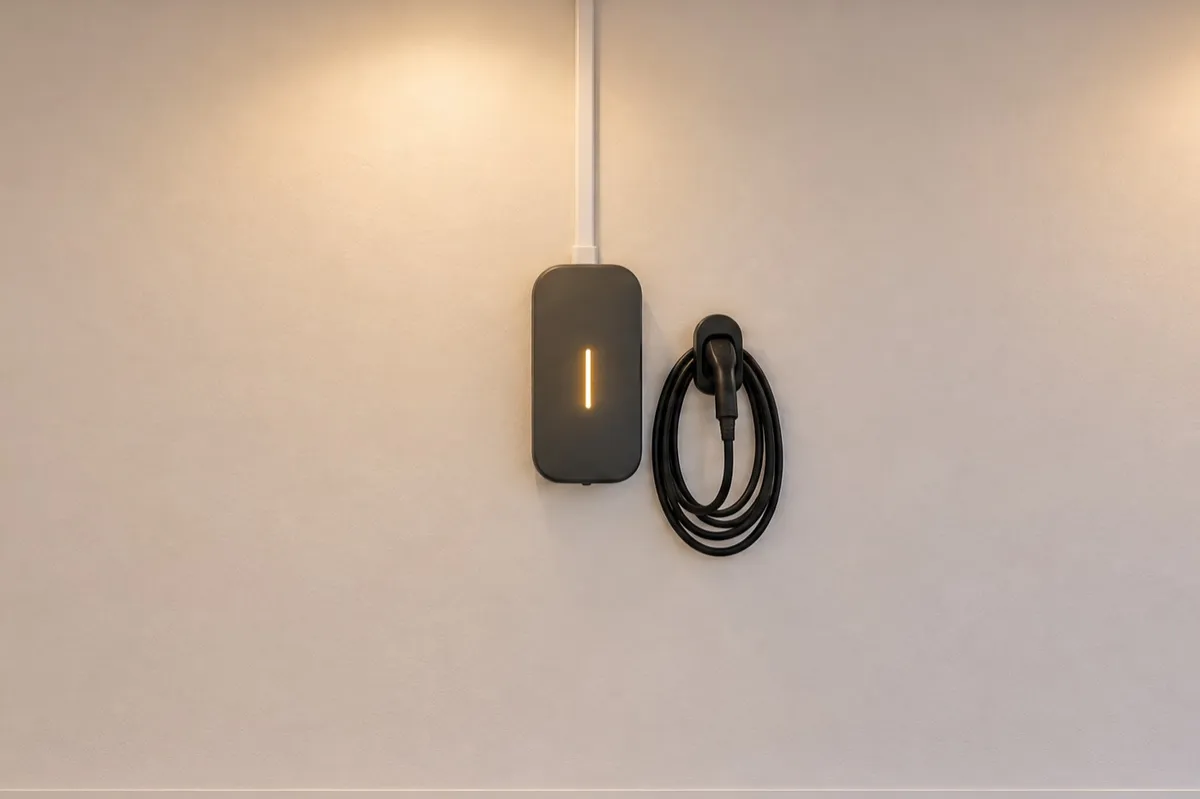
Picture at the top: made with AI, for illustration. It isn't a real job or a particular brand of charger.
How far does each option get you?
| How you charge | Range added in an hour | After 10 hours overnight |
|---|---|---|
| Standard 10 A power point | About 10 to 15 km | About 100 to 150 km |
| 15 A power point | Up to about 22 km | Up to about 220 km |
| Wall charger, single-phase, about 7 kW | About 35 to 50 km | Most cars are full by morning |
| Wall charger, three-phase, 11 kW | Up to about 75 km | Most cars are full well before morning |
These figures depend on the car and the charger. RACV says up to 15 km an hour on a standard point, and about 35 to 40 km on 7 kW. NRMA says 13 to 22 km across standard and 15 A points, and 38 to 45 km on 7 kW. Tesla's figures for a Model 3 or Model Y are 50 km at 7.4 kW and 75 km at 11 kW. Your car's portable charger also has to be able to use what a 15 A point can give.
When is a power point enough?
- You drive short distances most days, and you're home most nights.
- You've got a sound point near where you park, with no need for an extension lead.
- You've got a portable charger. Kia's Australian manual notes that one may not be supplied in every region, so check what came with your car.
Writing for RenewEconomy, Bryce Gaton suggests a wall charger if you need more than about 50 km of charge a day. Under that, a power point may be all you need, and we'll tell you so.
Is it safe to charge from a normal power point?
It can be, if the point is up to it. Charging isn't like running a kettle. Anthony Bennett, a licensed electrician writing for SolarQuotes, says the portable chargers he measured drew about 80% of the point's rated current, for hours at a time, and that this can overheat worn plugs and sockets. So:
- Don't use an extension lead. NRMA says they aren't generally designed for sustained high current over several hours. Kia says not to use one with its portable charger, because it may overheat, and warns that a cable reel may lead to fire or explosion. RACV says to avoid them unless the maker specifically approves.
- Don't use double adaptors or power boards.
- Have a licensed electrician check the point and circuit before you charge from it regularly. You can't see the wiring, or what else shares that circuit. Gaton says it should be in good condition, and wired direct to the switchboard on its own circuit. Kia says the outlet must comply with regulations and safely handle the charger's ratings. The NSW Government says homes built before the 1980s should have their wiring inspected anyway.
- Check there's a safety switch on that circuit. The NSW Government says homes built during or after 2000 usually have them, and strongly recommends asking a licensed electrician to check an older one.
- Turn the point off at the wall before you unplug. If the plug or socket is hot, discoloured, loose or melted, turn that circuit off at the switchboard, don't pull the plug, and call a licensed electrician.
- Keep it out of the weather. A point outdoors or in a carport needs to be weatherproof.
- Use a charger with the Regulatory Compliance Mark. That's the NSW Government's advice.
What does a 15 A power point do?
It's a step between a standard point and a wall charger. Some portable chargers can draw 15 A, and on a 15 A point they charge faster than on a standard one. A 15 A plug doesn't fit a standard 10 A socket, and you shouldn't adapt it to make it fit.
A 15 A power point on its own circuit is a smaller job than a wall charger, and it may be all you need if you drive short distances. It only helps if your portable charger takes 15 A, so check that first.
When is a wall charger worth it?
- A night on the power point often isn't enough. Gaton's rule of thumb is more than about 50 km a day, and NRMA adds longer commutes, irregular travel, several trips a day and regular weekend drives.
- You want to charge from spare solar, or on a schedule. Ausgrid says a charger with Wi-Fi and an app can schedule charging for off-peak or solar hours.
- You'd like the cable on the wall, ready each night, rather than unpacking a portable charger.
The NSW Government says a wall charger has to be installed by an electrician. It needs its own circuit, so we check your switchboard first. Next questions: which charger, single-phase or three-phase, and what changes the cost.
Not sure your power point is up to it, or whether you need more? Book a time for us to look. We'll tell you if a power point will do. If you need work done, you get the quote in writing. Once you say yes, the price doesn't move. If we open something up and find a real surprise, we stop, show you, and quote it before we go any further. We work across the Northern Beaches, the North Shore, the Eastern Suburbs and the Inner West.
Prefer to talk now? Call 0466 805 580.
Common questions
Can I use an extension lead just for tonight?
We wouldn't. NRMA and Kia both say not to use one with a portable charger, and RACV says to avoid them unless the maker specifically approves.
How long does a full charge take?
RACV's table gives 20 to 40 or more hours on a standard power point, and 8 to 12 hours on a 7 kW wall charger. Most nights you aren't starting from empty, so what matters is how far you drive each day.
Can you check my power point?
Yes. We can check it and tell you if a new point on its own circuit would be better. See our EV charger page.
Where this comes from
Sources checked on 7 November 2026.
- NRMA, Charging your EV at home (7 July 2026)
- RACV, How to charge an electric vehicle (10 September 2026)
- Tesla Support Australia, Wall Connector
- Kia Australia, EV5 owner's manual (MY26)
- RenewEconomy SwitchedOn, Do I need an EV charger at home? (Bryce Gaton, 3 March 2024)
- SolarQuotes, charging an EV from a power outlet (Anthony Bennett, licensed electrician, updated 22 October 2025)
- NSW Climate and Energy Action, Install a home electric vehicle charger (updated 9 July 2026)
- NSW Government, Electrical safety in the home
- Ausgrid, Getting the most out of your EV
