
Single-phase or three-phase: which do you need for an EV charger?
Most Australian homes are single-phase, and NRMA says that's typically up to 7 kW. That suits most drivers. 11 kW or 22 kW needs three-phase power and a car that can use it, so check your car first, then your house. If your house is single-phase, moving to three-phase is rarely worth it just for charging.
How do you know what your house has?
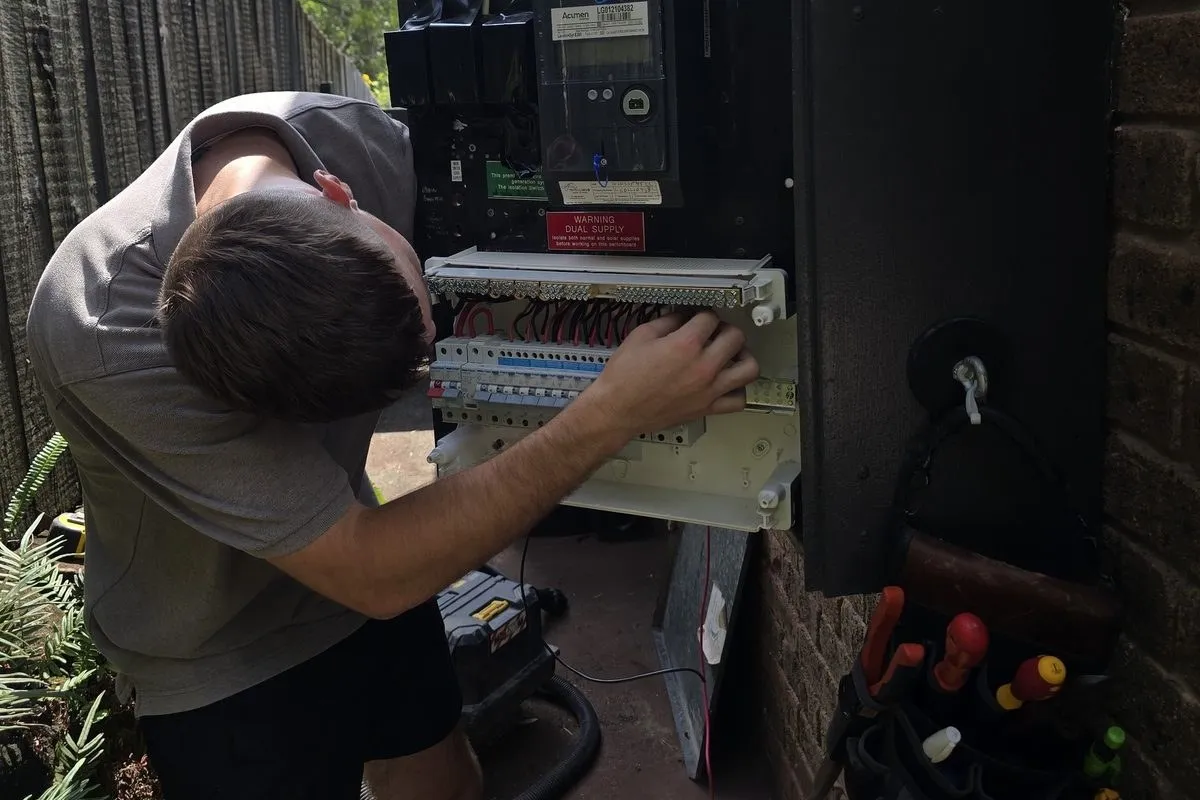
RACV has a simple check: look at the main switch at your switchboard. One main switch means single-phase, and three mean three-phase. A three-phase main switch can look like one wide switch, so if yours does, send us a photo. Don't remove any covers. We'll also check when we come and look.
What does each one give you?
| Supply | Output | Range added in an hour |
|---|---|---|
| Single-phase, 16 A circuit | 3.5 kW | Up to 25 km |
| Single-phase, 32 A circuit | 7.4 kW | Up to 50 km |
| Three-phase, 16 A circuit | 11 kW | Up to 75 km |
| Three-phase, up to 22 kW | 22 kW | About 120 to 130 km, if your car can take it |
The first three rows are Tesla's figures for a Model 3 or Model Y. The 22 kW row is NRMA's. Other cars differ: NRMA says about 38 to 45 km an hour at 7 kW, and RACV says about 35 to 40 km. We confirm a full 7 kW suits your supply before we quote it.
Why check your car first?
Because the car sets the limit. NRMA says many EVs are capped by their onboard AC charger, so a more powerful wall charger won't make them any faster. RACV says not all EVs in Australia support three-phase charging, and that some stop at 11 kW. Evnex makes the same point: speed is limited by the car's onboard charger.
Look up the maximum AC charge rate in your owner's manual. If it's about 7 kW, three-phase won't change much for you.
Do you really need more than 7 kW?
Probably not. NRMA says the average Australian drives under 40 km a day. At 7 kW, that's about an hour of charging. Even a long day's driving is usually back overnight, and on a 7 kW charger most cars are full by morning.
NRMA says three-phase suits homes that already have it, high daily driving, or more than one EV. If your house already has it and your car can take it, an 11 kW charger fills it faster. If it doesn't, we'd rarely suggest changing your supply just for this.
What does it take to change to three-phase?
More than fitting a charger. Both NRMA and RACV say it can be costly, and Ausgrid says all electrical work inside your property must be done by a licensed electrical contractor. In practice:
- Ausgrid says a supply upgrade needs its approval through a connection application, and recommends your electrician completes it.
- Work on the supply itself takes a Level 2 service provider. We tell you first and organise them.
- Your electricity retailer handles any meter and tariff changes. Ausgrid says a home over 20 years old that hasn't been rewired may need a meter upgrade for accurate billing.
- The switchboard may need work as well. Here's what we look for.
What if your supply is tight?
You may not have to go all the way to 7 kW. Tesla says the Wall Connector can be installed on a lower-rated circuit breaker to suit almost any existing electrical system. At 16 A on single-phase, Tesla's table shows up to 25 km an hour for a Model 3 or Model Y, which is plenty for many people overnight. If you drive even less, a power point may do.
Do you need to tell Ausgrid or the council?
- Ausgrid. Depending on the installation, you may need to notify Ausgrid before installing. We do that for you, or apply when your supply needs it.
- Council. A home charger is generally exempt development if it meets the State Policy's standards and any conditions on your existing consent, so council approval isn't needed. That's from a NSW Planning fact sheet of February 2023. Anything on public land does need approval.
- Strata. If you're in an apartment or townhouse, talk to your owners corporation first. A new right to install a charger on your lot is planned to start in 2027.
Stay out of the roof space and sub-floor. You don't need to go up or under to work any of this out. If your house was built or renovated before 1990, NSW Government advice is that it's likely to contain asbestos. So don't drill or cut walls, eaves or switchboard panels until you know what they're made of. In a home built before 1980, stay out of the roof space and sub-floor until testing rules out loose-fill asbestos insulation. Don't touch cables or insulation.
Not sure what your house has, or what your car can take? Book a time for us to look. We check your switchboard first, and if it needs work, the quote says so, line by line, before anything starts. We work across the Northern Beaches, the North Shore, the Eastern Suburbs and the Inner West.
Prefer to talk now? Call 0466 805 580.
Common questions
Can I get 22 kW on single-phase?
No. NRMA puts single-phase at typically up to 7 kW. A three-phase charger on single-phase runs at its single-phase rate, so check that figure before you buy: 3.68 kW on Fronius's Flex Home 11, and 7.36 kW on the Home 22.
Do you fit three-phase chargers?
Yes, if your house already has three-phase power and your car can take it.
Which charger should I get?
It depends on your car, your house and your solar. Here's how to work it out, or see our EV charger page.
Where this comes from
Sources checked on 7 November 2026.
- NRMA, Charging your EV at home (7 July 2026)
- RACV, How to charge an electric vehicle (10 September 2026)
- Tesla Support Australia, Wall Connector
- Evnex, BYD compatibility
- Ausgrid, EV Charging
- NSW Department of Planning, Electric vehicles fact sheet (February 2023)
- NSW Government, Guide to strata law changes (updated 26 October 2026)
- NSW Government, Asbestos (NSW Planning)
- NSW Government, Working in pre-1980 built homes (loose-fill asbestos insulation)
